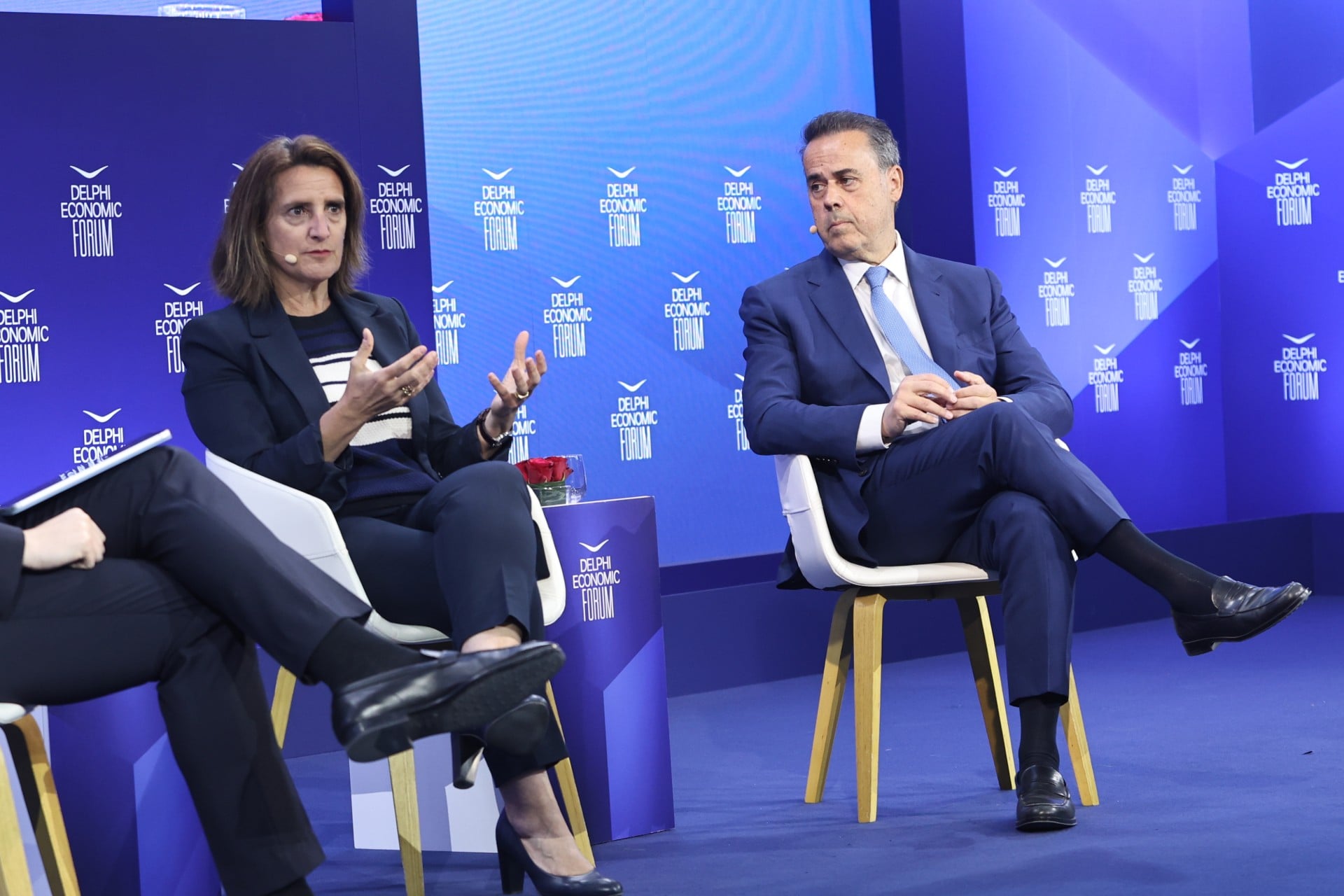
Realism is necessary in the energy transition, Environment and Energy Minister Stavros Papastavrou said on Friday, speaking at the Delphi Economic Forum XI in a discussion with the Executive Vice-President of the European Commission for a Clean, Just and Competitive Transition, Teresa Ribera.
“For years, decarbonization was treated as a holy grail, not only in Brussels but also in many other countries, and was interpreted as something that took precedence over social cohesion, competitiveness or deindustrialization. Now we all realise that it is not an end in itself. We understand how important it is that, without sacrificing environmental protection and the need to reduce emissions, we move forward — but in a realistic way and in a technologically neutral manner,” Papastavrou stressed.
Asked about the energy crisis, he underlined that in 2022 it took more than a year for Member States to acknowledge the need to take action and begin discussions. “This time it took only two weeks. Europe does not have perfect reflexes, but it has proven that when a crisis comes, it has the strength and maturity to take measures,” he noted, adding: “It is clear that we must adopt targeted measures that protect social cohesion and do not undermine fiscal balance, but at the same time do not create inequalities. At the same time, we must move towards a unified European energy market.”
The minister referred to Greece’s progress in its energy mix, noting that in 2005 the country covered over 65% of its electricity needs from lignite, while in 2025 lignite has fallen below 8% and renewable energy sources have reached 55%. “The share of renewables in Greece’s energy mix places the country 7th globally. And if we compare greenhouse gas emissions over the same period, they are down by more than 50%. This shows that environmental protection is not a luxury. It is something society can support, as long as it is pursued in realistic terms and takes into account economic competitiveness and social cohesion,” he said.
Referring to the EU directive on energy networks, he noted that many countries openly opposed it. “We fought a major battle. I hope that developments in the Middle East will lead to the approval of the network package in June,” he underlined.
On her part, the Vice-President of the European Commission noted that the EU is more resilient to crisis than in 2022. “We are in a better position. We know how to respond; we know we must act jointly and swiftly. That is why the impact is not as great as during the Ukraine crisis,” Ribera said.