
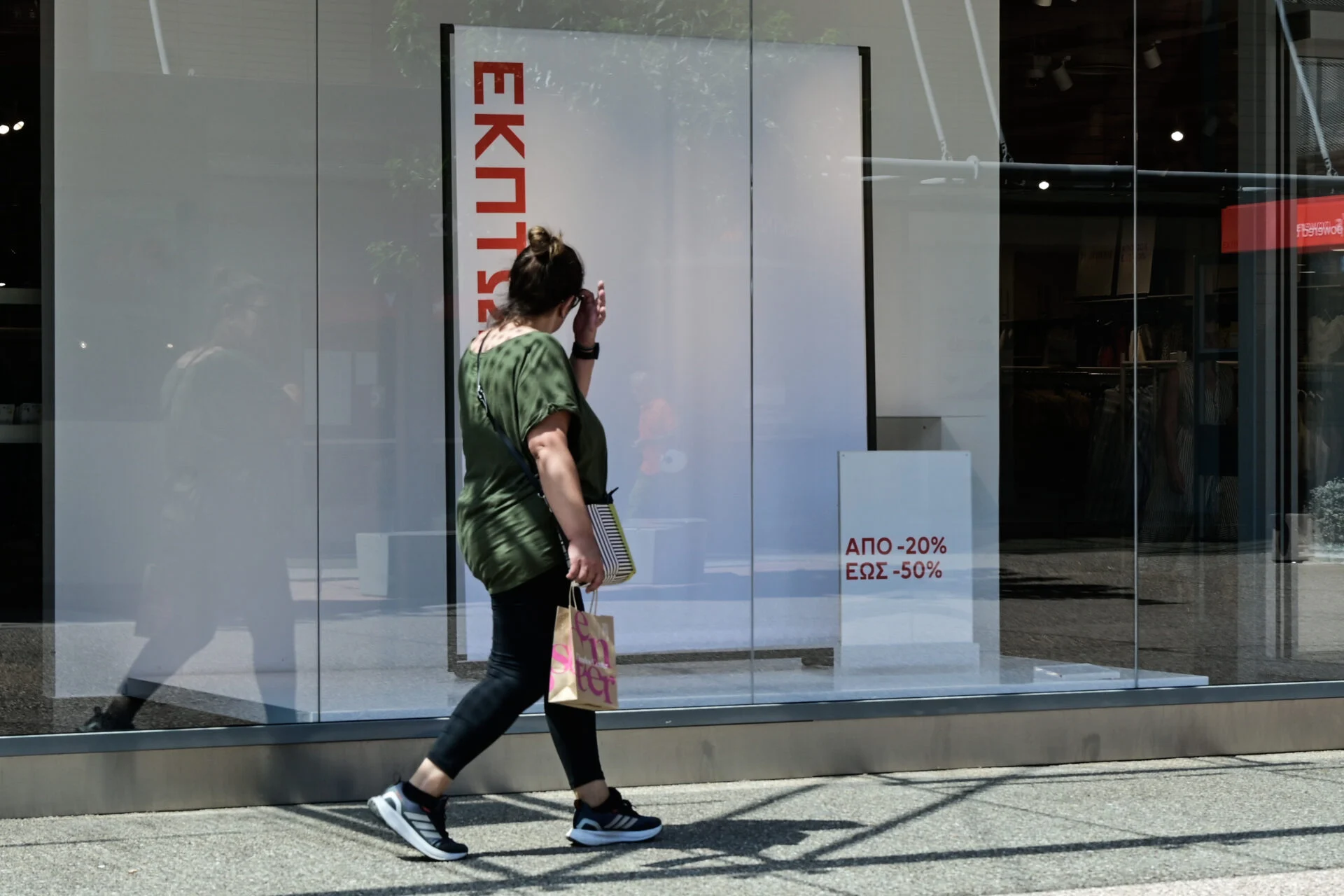
Lower prices failed to attract consumers, who are redirecting their disposable income towards essential goods and services, amid international fragmentation and heightened uncertainty, the Hellenic Confederation of Commerce and Entrepreneurship (ESEE) said in a statement on the findings of its nationwide survey on the performance of the summer sales, which ended on Monday.
“During this year’s summer sales, almost six in 10 retail businesses recorded lower turnover, while only one in 10 posted higher turnover compared with the corresponding period last year. This development comes on top of a first half of the year marked by weak sales and reflects the pressures and turbulence affecting the market,” the statement added.
As a result, the viability of businesses is being called into question, with business owners pinning their final hopes on measures to ease the burden of costs and charges expected to be announced at the Thessaloniki International Fair (TIF).
The main findings of the survey are as follows:
-Almost six in 10 (57.5%) retail businesses recorded weaker sales during the summer sales compared with last year, while only one in 10 posted higher turnover.
-Almost half of businesses (47.2%) were slightly or not at all satisfied with their turnover during this year’s summer sales.
-The need to further boost sales is prompting almost four in 10 business owners (37.7%) to maintain low prices and promotional offers after the official end of the sales, despite the restrictions imposed by the relevant regulatory framework.
-Against this backdrop, it is hardly surprising that almost six in 10 businesses (57.6%) offered discounts of more than 30%, with the 31%-40% discount bracket proving the most popular.
-For more than four in 10 businesses (44.3%), July was the period with the highest level of shopping activity. This finding is consistent with previous surveys, with the exception of last year, when the first half of August was recorded as the strongest sales period.
-For more than five in 10 businesses (53.3%) that recorded lower sales than during the corresponding sales period last year, the decline was up to 10%. While this result is an improvement on last year, it cannot be considered positive.
-Similarly, for around half of the businesses (52.2%) that reported higher sales, the increase did not exceed 10% compared with last year.
-Two in three businesses (66.0%) offered the same discount rates as in summer 2025, highlighting the market’s limitations.
-Four in 10 businesses (41.5%) offered discounts on all merchandise in their shops without exception.
-In addition, four in 10 businesses (43.9%) recorded lower footfall than during the corresponding period last year, a figure almost identical to the 42.5% of businesses that assessed their footfall as being at last year’s levels.
-Only 16.0% of business owners said they were very satisfied with footfall at their shops.
-Despite the growing digital maturity of businesses and consumers in recent years, three in four business owners (75%) said sales through their online stores were lower than those generated by their physical shops. This figure, significantly higher than last year, highlights both the need for incentives to further accelerate the digital transition and the established preferences of domestic consumers, for whom shopping is often combined with other activities, such as entertainment and socialising with friends.
-Business owners rank inflation, consumers’ reduced disposable income for purchases, rising operating costs and higher supplier prices, in that order, as the most significant problems weighing on businesses.
-For eight in 10 businesses (81.2%), operating costs have increased by up to 20% since the beginning of the year, driven by higher energy prices. This burden cannot be considered insignificant, particularly given the cumulative impact of energy costs on operating expenses in recent years.
-Business owners are pessimistic about the effectiveness of EU measures aimed at curbing the activity of Asian digital platforms. Almost six in 10 business owners (57.6%) believe that these measures will either have no impact at all on platform sales or will curb them only to a very limited extent.
-As regards individual sectors, educational, entertainment and sporting goods appear to be facing the strongest pressures, followed by clothing and footwear.
Προτιμώμενη πηγή στην Google
Για να εμφανίζονται περισσότερα άρθρα της Ναυτεμπορικής στις αναζητήσεις σας εύκολα και γρήγορα, πρέπει να προσθέσετε το site στις προτιμώμενες πηγές σας. Μπορείτε να το κάνετε πηγαίνοντας εδώ.