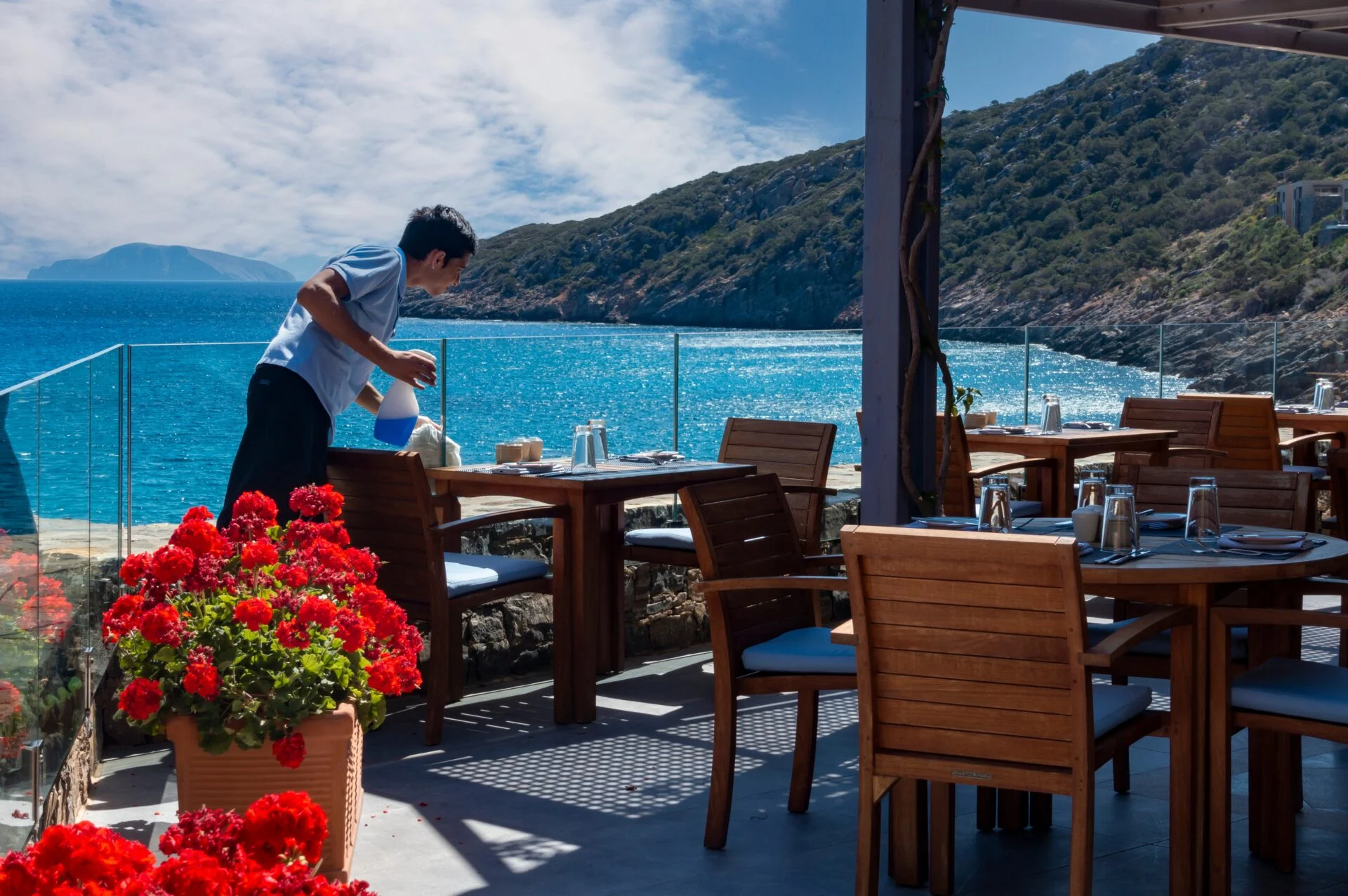
Around one in three young people aged 15-29 in Greece is employed, with 55% of those working in trade, transport, accommodation and food services.
The gap compared with 2008, before the crisis, is substantial. At the time, 39% worked in these sectors, with the 16-percentage-point increase now largely — 90% — driven by accommodation and food services.
This is one of the particularly worrying findings in the OECD report on the challenges facing young people in Greece as they seek to achieve economic independence. It is concerning because this overreliance on tourism is fragile, and therefore risky, as a foundation for an entire generation’s future. Tourism is vulnerable to any disruption; it is the first thing people cut back on when things go wrong, whether on the global political stage or in a household’s finances. Tourism, which falls under leisure, cannot serve as the foundation of an economy. It is an excellent component of an economy, but not its foundation, because of its inherent volatility.
The question is how tourism came to play such a prominent role in the Greek economy. There is, of course, no single reason why we got here. The economic crisis of the previous decade, the lack of productive investment and poor education, which has created a skills mismatch, are among the factors behind the economy’s overreliance on tourism
The economic crisis of the 2010s sent youth unemployment soaring to 48.7%, with one in two young people out of work. This happened because a number of businesses were unable to survive the economic crisis and closed permanently, resulting in the permanent loss of jobs.
In 2025, the unemployment rate fell to 16.5%, roughly returning to its 2008 level. However, the employment rate remains lower than in 2008, at 36% compared with 43%. This means either that the share of young people in education has increased, or that the share of young people who are NEETs — or both, which is the more likely scenario — has risen. In the EU, the employment rate stands at 55%, and in the OECD at 50%. The gap from Greece’s 36% is substantial.
Global tourism boom
Greece’s economic recovery coincided with a global tourism boom that reached unprecedented levels following the pandemic. Strong demand for workers in tourism offered an obvious solution for some young people looking for work but unable to find it. Many leave for seasonal jobs on the islands, not because the pay is satisfactory, but because they have few other options. As a result, despite the low wages, they are effectively pushed towards the sector.
Youth unemployment in Greece is high regardless of educational attainment. Among 25- to 34-year-olds, the unemployment rate for university graduates stood at 12.3% in 2024, the highest among OECD countries and 2.4 times the OECD average. Greece also ranks at the top for young people with upper-secondary or post-secondary non-tertiary education, while only Slovakia has a higher unemployment rate among those with no more than compulsory education, according to the report.
Seasonal work on the islands is the obvious option because it requires little training and is accessible to almost everyone. It therefore absorbs a large share of the unemployed, but offers seasonal employment, poor working and living conditions and low pay. This is also why there are so many vacancies in the sector.
Young workers in Greece have the lowest monthly wages compared with their counterparts in other European countries. Workers under 30 in Greece earn an average of 40% less than their peers elsewhere in Europe, taking into account purchasing power parity for comparability, the report says.
Those who can and dare to move abroad can earn significantly more. Others turn to self-employment out of necessity, seeking to escape extremely low wages. As a result, the share of young self-employed workers stands at 11%, one of the highest rates in the EU.
This is a longstanding issue in Greece, dating back decades, when part of the population, following the Civil War, was excluded from many aspects of economic and social life and self-employment was often the only option. Today, it is a solution for those who cannot make ends meet on the minimum wage.
Construction and manufacturing accounted for 13% of employment in Greece in 2008, compared with just 3% in 2023. In the EU and OECD, the corresponding figures were 11% in 2008 and 7% in 2023, representing a much smaller decline than in Greece.
Greece has experienced a greater loss of jobs, pushing young people towards tourism. On the one hand, there is strong demand for tourism in Greece, while on the other, employment in construction and manufacturing has declined. The shift towards tourism is therefore understandable, but potentially dangerous in the long term.
Young people who turn to accommodation and food services out of necessity can become trapped in the sector, unless they view it as a temporary solution. This poses a major risk to their future because they fall behind in education and skills.
They live off their seasonal earnings, time passes, their youth slips away and their opportunities to pursue other careers diminish. If tourism were to fall back to its previous levels, there would be a major loss of jobs. The first signs are already visible in the food-service sector — hardly surprising, since half of Greece spends its time making coffee for the other half.
Προτιμώμενη πηγή στην Google
Για να εμφανίζονται περισσότερα άρθρα της Ναυτεμπορικής στις αναζητήσεις σας εύκολα και γρήγορα, πρέπει να προσθέσετε το site στις προτιμώμενες πηγές σας. Μπορείτε να το κάνετε πηγαίνοντας εδώ.